How EDR Killers Bypass Security Tools
By 0xSnow on March 19, 2026


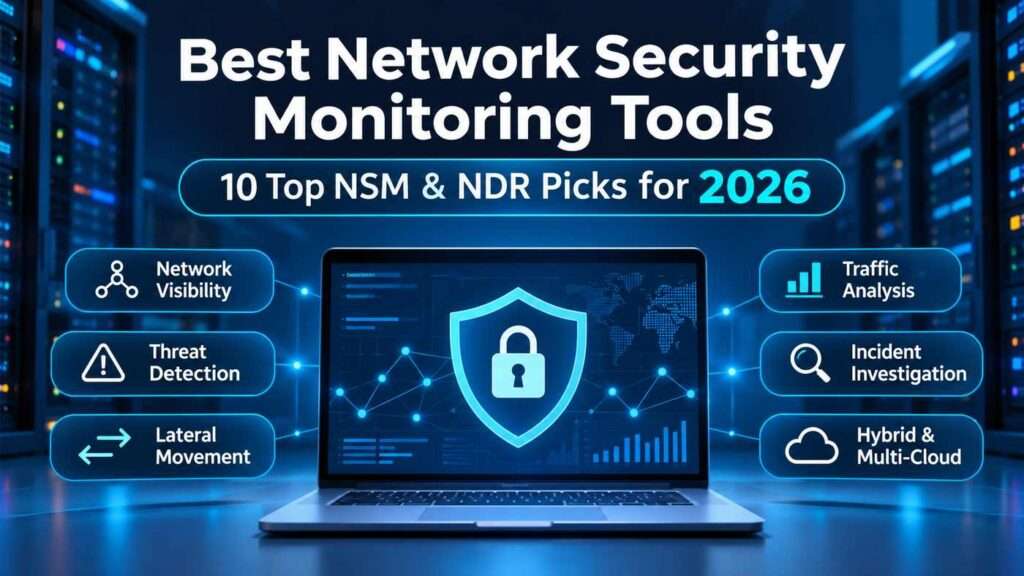
Network security monitoring (NSM) and network detection and response (NDR) tools help security teams monitor network traffic, detect suspicious behavior, identify threats, and investigate attacks across on-premises, cloud, and hybrid environments.
Below are 10 of the best NSM and NDR tools to consider in 2026, including enterprise platforms, open-source solutions, and specialized tools for OT, ICS, and IoT environments.
A network security monitoring tool analyzes network traffic, packets, metadata, and protocols to detect suspicious activity and potential threats. Unlike traditional network monitoring tools, which focus mainly on performance and availability, NSM and NDR tools are designed to identify and investigate security threats.
Best for: AI-Driven Behavioral Network Detection
DEPLOYMENT: Cloud, virtual, and physical appliance options PRICING: Starts at $30,000/year (AWS Marketplace, covering up to 300 Mbps and 200 hosts).
Overview:
Darktrace / NETWORK uses machine learning and behavioral analysis to establish an understanding of normal activity across an organization’s network and identify anomalous behavior. It can monitor network activity across on-premises, cloud, and hybrid environments and surface suspicious behavior for investigation.
Darktrace also provides autonomous response capabilities that can take targeted action against anomalous network activity without requiring manual scripting for supported response actions.
Pros: Catches novel behavioral anomalies without signatures and supports automated threat containment.
Cons: Requires careful early tuning to manage false positives and carries enterprise pricing.
🏆 Best High-Speed East-West Traffic Visibility & Decryption
DEPLOYMENT: Cloud, Virtual, and Hardware Sensors PRICING: Quote-based (tiered by throughput and modules)
Overview:
ExtraHop RevealX captures full packets across OSI layers 2 through 7 at line-rate speed and decrypts SSL and TLS 1.3 traffic. It decodes over 70 protocols in real time to give SOC teams deep east-west visibility and fast forensic investigation.
Pros: Deep wire-data inspection with TLS 1.3 decryption and rich protocol decoding at scale.
Cons: High cost and extra modules for IDS or forensics increase total spend.
🏆 Best Hybrid & Multi-Cloud Attack Signal Intelligence
DEPLOYMENT: Cloud-native SaaS with hybrid network sensors PRICING: Quote-based (enterprise subscription)
Overview:
Vectra AI correlates threat signals across data center networks, public cloud, SaaS, and identity systems in one console. Its Attack Signal Intelligence helps security teams prioritize active attacker behavior and respond quickly across hybrid environments.
Pros: Strong cross-domain signal correlation and clear alert prioritization for SOC teams.
Cons: Geared toward mid-to-large enterprises with dedicated security operations staff.
🏆 Best All-in-One Open-Source NSM Platform
DEPLOYMENT: On-Premises / Self-Hosted Linux Distribution PRICING: Free & Open-Source (commercial hardware/support optional)
Overview:
Security Onion packages Zeek, Suricata, Elasticsearch, and case management tools into a unified open-source security monitoring distribution. Security analysts use it for intrusion detection, full packet capture, log management, and threat hunting from one interface.
Pros: Completely free, turnkey open-source stack combining signature IDS, metadata, and threat hunting.
Cons: Demands substantial server hardware and ongoing admin effort to size and maintain.
🏆 Best High-Fidelity Network Traffic Metadata Framework
DEPLOYMENT: Self-Hosted Linux / BSD Sensors PRICING: Free & Open-Source
Overview:
Zeek is an open-source network analysis framework that turns raw wire traffic into structured, high-fidelity protocol and connection logs. Organizations run it on high-volume links to feed SIEMs and threat-hunting pipelines without storing full packet captures.
Pros: Scales cleanly on busy networks and produces clean, searchable traffic logs.
Cons: Not a plug-and-play GUI dashboard; requires scripting and a SIEM or log stack to visualize.
🏆 Best Open-Source Intrusion Detection & Prevention Engine
DEPLOYMENT: Self-Hosted Linux / Network Tap or Inline PRICING: Free & Open-Source
Overview:
Suricata is a multi-threaded open-source engine that performs real-time intrusion detection (IDS), inline intrusion prevention (IPS), and network security monitoring. It inspects traffic against rule sets, extracts files, and outputs structured JSON logs for fast alert triage.
Pros: Fast multi-threaded packet processing with strong rule-based detection and inline blocking.
Cons: Signature-based rules need regular updates and tuning to avoid noisy alerts.
🏆 Best Open-Source Packet Capture & Forensic Analyzer
DEPLOYMENT: Desktop Application (Windows, macOS, Linux) PRICING: Free & Open-Source
Overview:
Wireshark is the standard open-source protocol analyzer used to capture and inspect live or saved network packets down to individual bytes. Security engineers rely on it for deep manual forensic analysis and troubleshooting suspicious traffic slices.
Pros: Unmatched protocol decoding depth and completely free for manual packet forensics.
Cons: Built for manual point-in-time inspection rather than automated 24/7 network monitoring.
🏆 Best Unified Open XDR & NDR for Lean SOCs & MSSPs
DEPLOYMENT: Cloud, On-Premises, or Hybrid PRICING: Quote-based (data-volume or sensor licensing)
Overview:
Stellar Cyber unifies NDR, next-gen SIEM, threat intelligence, and automated response into one integrated security operations platform. It uses multi-layer AI and integrates with existing firewalls, EDR, and cloud tools to simplify investigation workflows.
Pros: Combines NDR, SIEM, and automated triage in one workspace with broad third-party integrations.
Cons: Broad platform scope takes planning to configure across multiple data sources.
🏆 Best OT, ICS & IoT Network Security Monitoring
DEPLOYMENT: On-Premises Sensors with Cloud (Vantage) or Local Console PRICING: Quote-based (tiered by sensors and asset count)
Overview:
Nozomi Networks uses passive deep packet inspection to discover and monitor industrial control systems, OT, and IoT devices without disrupting operations. It combines behavioral anomaly detection with CVE correlation to protect critical infrastructure.
Pros: Deep visibility into specialized OT/ICS protocols and strong vulnerability correlation.
Cons: Mixed IT/OT networks can produce extra alert noise without active tuning, and multiple UI views take time to learn.sources.
🏆 Best Agentless Asset Intelligence Across IT, OT & IoT
DEPLOYMENT: Cloud SaaS with passive network collectors PRICING: Quote-based (per-asset subscription)
Overview:
Armis Centrix passively discovers and profiles managed and unmanaged devices across IT, cloud, OT, and IoT networks without agents. Its AI-driven engine detects behavioral deviations and lateral movement while integrating with existing SIEM, SOAR, and NAC tools.
Pros: Agentless discovery of unmanaged IoT/OT hardware and smooth SIEM/SOAR integrations.
Cons: Licensing costs scale up quickly as connected device counts grow, and initial rollout needs dedicated staff.