

How EDR Killers Bypass Security Tools
By 0xSnow on March 19, 2026


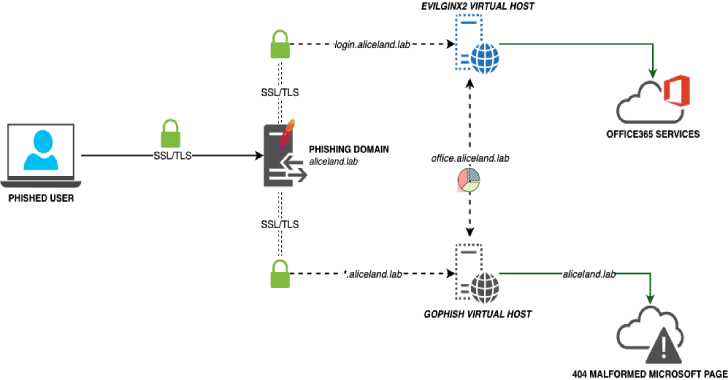
EvilGoPhish is a project that combines concepts from Evilginx2 and GoPhish to support phishing simulation campaigns and centralized campaign reporting. It aims to connect email engagement metrics with activity recorded by a reverse-proxy-based authentication test environment.
For authorized penetration tests and red-team engagements, phishing simulations can help organizations evaluate employee awareness, authentication controls, and incident-response procedures. However, tools that proxy authentication sessions can also expose passwords, session cookies, and other sensitive authentication data. They should only be used within a clearly approved scope and with appropriate safeguards.
EvilGoPhish combines the campaign-management and email-tracking capabilities associated with GoPhish with the reverse-proxy concepts used by Evilginx2. The goal is to correlate campaign activity with events observed during an authorized authentication-security assessment.
Traditional phishing simulation platforms commonly report events such as email delivery, message opens, link clicks, and landing-page interactions. Reverse-proxy-based authentication testing introduces additional security considerations because it may expose authentication data beyond the events normally collected by an awareness campaign.
For a closer look at its email campaign component, read our guide to Gophish, the open-source phishing toolkit, which covers its role in authorized phishing engagements and security-awareness training.
The project described in this article addresses two reporting and session-management challenges:
Security teams need reliable metrics to understand how users respond to simulated phishing messages. Without consistent event tracking, a campaign may not provide enough information to evaluate awareness training or compare results across test groups.
Useful metrics for an authorized awareness exercise can include:
Email-open tracking is not a perfect measure of engagement. Privacy features, image proxies, and automated scanners can affect whether an open is recorded. Similarly, automated security tools may visit links without a person interacting with the message. Campaign reports should therefore be interpreted alongside other evidence rather than treated as definitive proof of user behavior.
In corporate networks, multiple users may share one public IP address because of network address translation (NAT), secure web gateways, or forward proxies. Local reverse proxies can also make requests appear to originate from the same address.
If a testing application relies too heavily on IP addresses to distinguish sessions, activity from different users can be incorrectly associated with the same session. This can reduce the reliability of campaign reporting and complicate investigation of test results.
For assessment environments, session attribution should be designed around privacy-conscious, campaign-specific identifiers and validated event records rather than assuming that an IP address uniquely identifies a person. Any identifiers collected should be protected and retained only as long as the engagement requires.
The project brings together components with different responsibilities. In a typical conceptual deployment, the email campaign platform manages messages and reporting, a reverse proxy may be used to assess authentication flows in a controlled test, and a web server routes incoming requests to the appropriate application.
| Component | General responsibility |
|---|---|
| GoPhish | Campaign management, email templates, recipient groups, and engagement reporting. |
| Evilginx2 | Reverse-proxy-based authentication testing. Depending on its configuration, it can expose sensitive authentication material and therefore requires strict controls. |
| Apache HTTP Server | Web request handling, reverse proxying, access logging, and routing between approved application endpoints. |
| Campaign reporting | Correlating authorized test events and producing reports for the assessment team. |
In the original design, the public-facing web server acts as an entry point and routes requests to different local services according to the requested hostname. The applications can maintain separate logs, helping administrators investigate routing behavior and diagnose reporting discrepancies.
Exact ports, hostname mappings, certificate paths, and application behavior depend on the deployment and software versions. They should be documented and validated against the configuration used in the authorized test environment.
The original project describes helper scripts for configuring domains, routing, redirects, and campaign identifiers. Before using any third-party automation, review the source code and understand every change it makes to the server, web server, certificates, and application configuration.
For a controlled security assessment, the deployment plan should address the following areas:
Before launching a phishing-awareness exercise, validate the campaign in a dedicated test environment. Start by confirming that approved test messages are delivered as expected and that reporting events are recorded consistently.
A responsible validation checklist includes:
Combining email campaign tracking with authentication-proxy testing creates risks that do not arise in every conventional awareness campaign. A reverse proxy capable of observing an authentication flow may handle highly sensitive information, including session material that can be used to impersonate an authenticated user.
Additional concerns include:
Use phishing simulations to evaluate defensive controls without collecting real user credentials or retaining reusable session tokens. Where an engagement specifically requires testing resistance to adversary-in-the-middle attacks, agree on a controlled method with the system owner and use designated test accounts, strict data-handling rules, and an explicit stop procedure.
Many organizations can measure the effectiveness of phishing-awareness training without deploying an authentication proxy that captures live session material. A conventional GoPhish campaign can track message engagement and direct participants to a controlled landing page that records the intended training outcome.
For authentication-resilience assessments, teams can separately evaluate phishing-resistant multifactor authentication, such as passkeys or FIDO2 security keys, and review identity-provider logs for suspicious sign-ins. This approach can provide useful defensive evidence while reducing the risk of collecting reusable authentication secrets.
Official project documentation is a good starting point for understanding the supported capabilities and security considerations of the individual components:
EvilGoPhish illustrates how phishing-campaign reporting can be connected with more advanced authentication-security testing. Its central concepts include campaign-event correlation, reverse-proxy architecture, and the challenge of distinguishing users whose traffic shares an IP address.
For security teams, the most important considerations are reliable metrics, carefully scoped testing, protection of sensitive authentication data, and secure infrastructure configuration. Choose the least intrusive method that answers the assessment question, document the limitations of the results, and ensure that all testing remains authorized and controlled.


