


How EDR Killers Bypass Security Tools
By 0xSnow on March 19, 2026



Hayabusa is an open-source Windows event log analysis and threat-hunting tool developed by Yamato Security. Written in Rust, it uses multi-threading and Sigma-compatible detection rules to help security analysts investigate Windows activity, generate forensic timelines, and identify potentially suspicious events faster.
Instead of manually reviewing large volumes of Windows Event Log data, analysts can use Hayabusa to process event logs and consolidate relevant results into structured timelines. These outputs can then be reviewed with tools such as Timeline Explorer, LibreOffice, Elastic Stack, or Timesketch during digital forensics and incident response (DFIR).
Hayabusa supports several investigation workflows, from examining a single computer to analyzing collected logs across an enterprise. Key capabilities include:
Hayabusa is written in Rust and uses detection rules to help reduce the amount of raw event data investigators need to examine. Detection results still require context and validation because legitimate administrative activity can resemble malicious behavior.
Windows event logs can contain useful evidence about account activity, process execution, system changes, and other security-relevant events. However, the volume of records can make manual analysis slow. Hayabusa processes supported event logs, evaluates applicable detection rules, and organizes results into a timeline that investigators can filter and review.
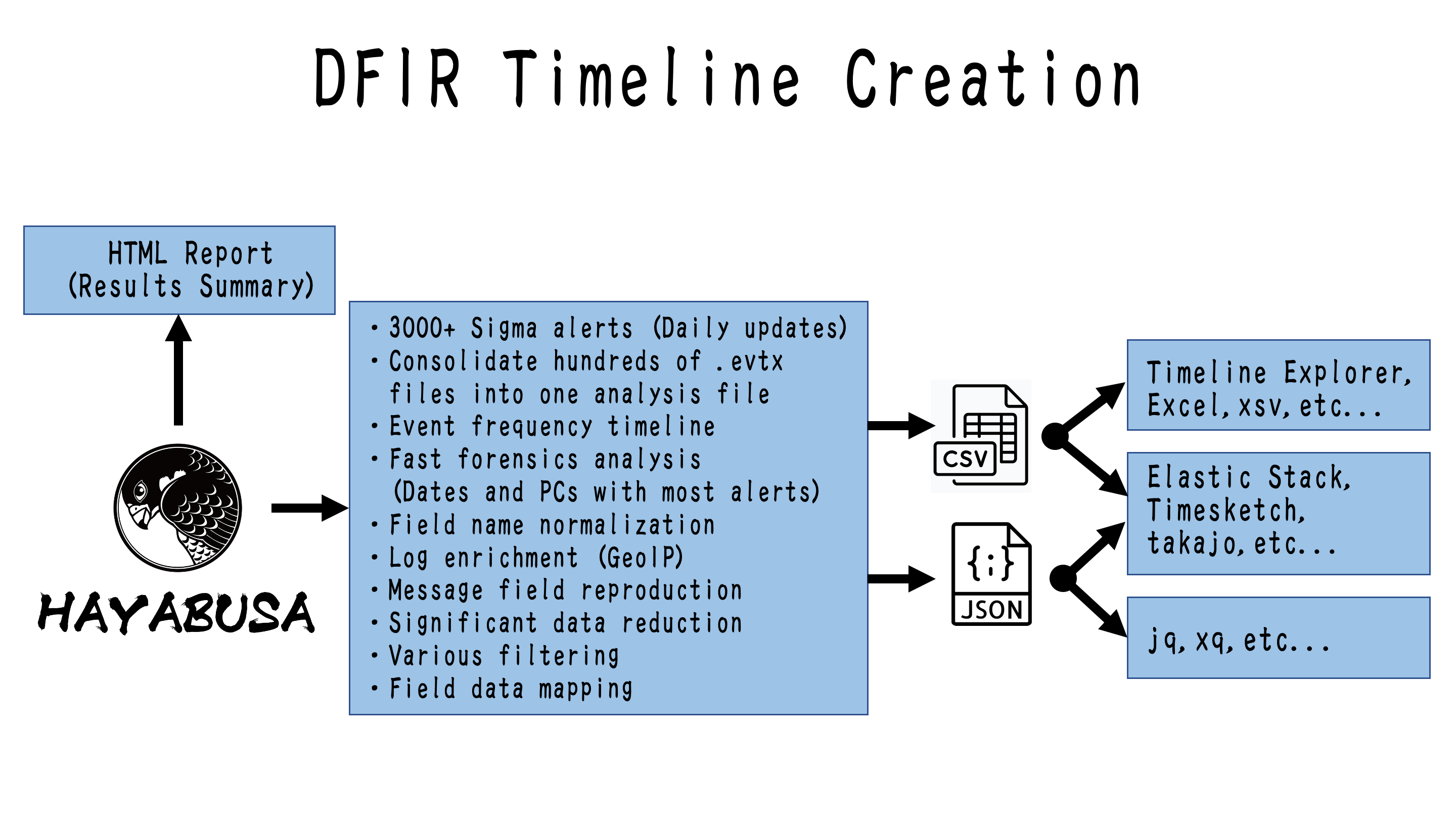
Investigators can inspect the generated data using spreadsheet applications or dedicated timeline analysis tools. This makes it easier to correlate events, identify suspicious patterns, and prioritize records that deserve closer examination.
Sigma provides a widely used format for describing security detection logic across different platforms. Hayabusa supports Sigma-based detections alongside its own rules, allowing analysts to identify potentially suspicious Windows events using reusable detection content.
Teams can review available rules, adjust detection logic for their environment, and keep their rule sets updated as threats and investigation requirements change. Rule quality and compatibility matter, so analysts should review detections and test changes before using them in production investigations.
For investigations involving multiple endpoints, Hayabusa can work with Velociraptor through its Hayabusa artifact. This combination supports collecting and analyzing event logs across managed systems, helping incident responders investigate activity that might otherwise remain scattered across individual machines.
Consolidated results can help teams investigate timelines across endpoints and prioritize suspicious activity. Hayabusa and Velociraptor can complement an existing SIEM or assist with retrospective investigations where centralized log analysis is limited, but they do not automatically replace every SIEM capability.
The startup output provides information about the analysis process, including event log processing and detection-rule loading. The exact output depends on the version, configuration, input files, and selected analysis options.

For reliable results, preserve original event logs, record the tool version and configuration, and verify important findings against the underlying event records. Analysts investigating broader security incidents can also consult this guide to forensic tools and investigation workflows.
Download the latest available release and review the official documentation before running an investigation. The project provides setup instructions, command references, detection-rule guidance, and information about importing results into analysis platforms.
Use the official command reference for current options and syntax, and test the workflow against sample event logs before applying it to evidence from a live incident.


