

How EDR Killers Bypass Security Tools
By 0xSnow on March 19, 2026


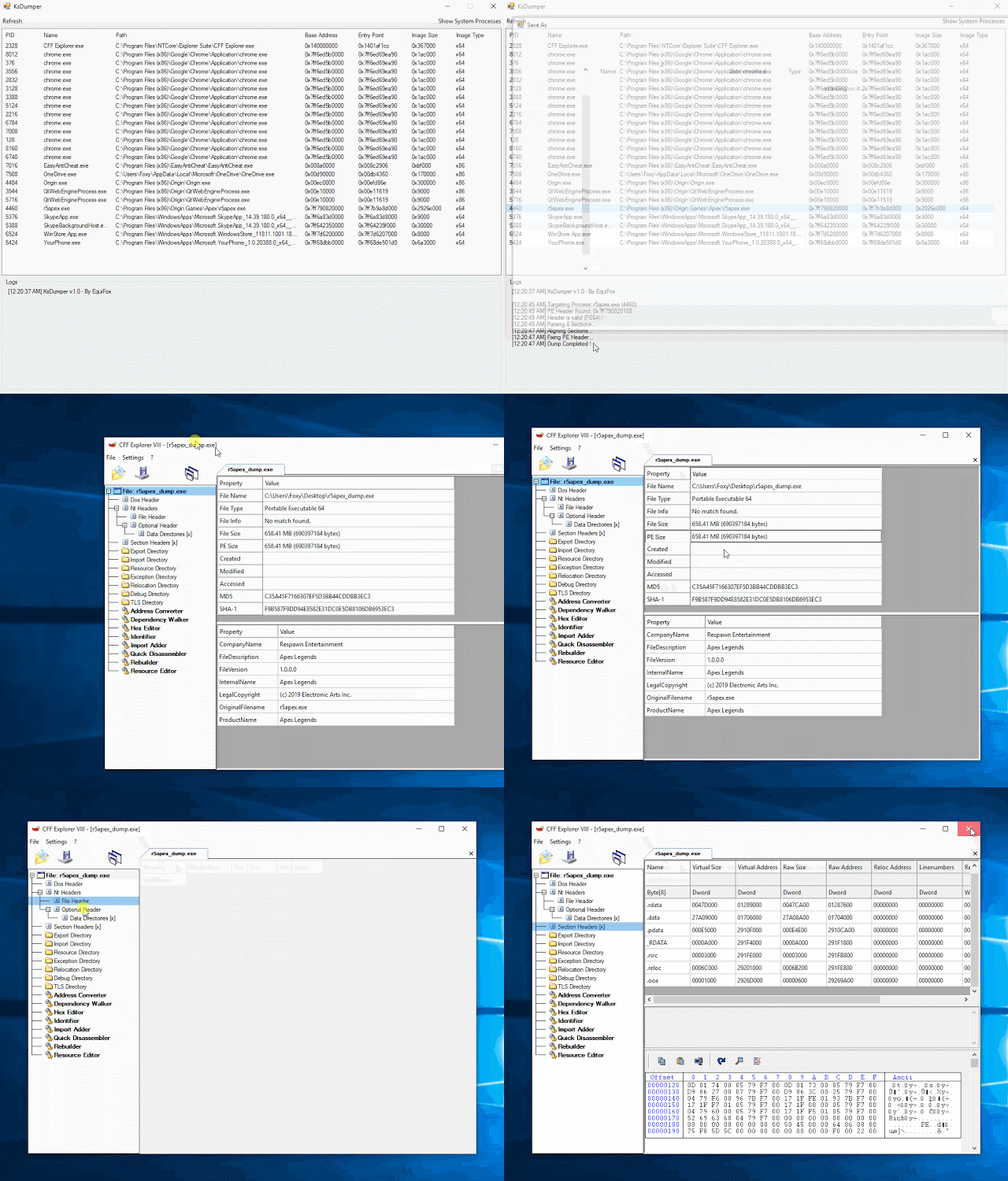
KsDumper is a Windows process memory dumping tool that uses a custom kernel-mode driver to access a process’s main executable module without relying on the standard OpenProcess API. It was developed as a reverse-engineering project to explore Windows kernel internals, Portable Executable (PE) structures, and interactions between user mode and kernel mode.
The tool is intended for authorized research, debugging, and malware analysis in isolated lab environments. Its kernel-level access can bypass some restrictions that prevent ordinary user-mode tools from reading a process, but loading an unsigned driver introduces significant system security and stability risks.
Important limitation: KsDumper does not rebuild the import table. A dumped executable may therefore require additional repair before it can be analyzed or used as a functional standalone binary. Results also depend on the target process and the state of its in-memory image.
Windows applications normally interact with other processes through user-mode APIs and access controls. KsDumper uses a kernel-mode driver to access process memory through a different execution boundary. This approach can retrieve a main module even when ordinary user-mode access is restricted, provided the driver and target environment support the operation.
The tool then reconstructs the PE headers and sections from the data it obtains. Since the import table is not rebuilt, the output should be treated as a memory dump rather than a guaranteed, ready-to-run executable. Analysts can inspect the result with suitable reverse-engineering and forensic tools.
The original KsDumper project lists the following build requirements:
The original driver-loading method relies on an unsigned driver and the Capcom driver-mapping approach. This legacy method may not work on updated Windows installations because driver-loading techniques and vulnerable drivers can be blocked by security updates and system protections. Review the original KsDumper repository for project details and compatibility notes before attempting to build it.
Run the original project only inside a disposable virtual machine with a snapshot and no sensitive data. Loading kernel drivers can crash Windows, trigger security controls, or leave a driver active after the client closes. The original instructions state that the driver may remain loaded until the system restarts.
Do not disable security protections on a primary workstation to make an outdated driver work. Use a dedicated research environment, retain a recovery snapshot, and restrict testing to systems and processes you are authorized to examine. Dumping protected game processes may also trigger anti-cheat detection and account penalties.
For related web security testing, see Corsy, a CORS misconfiguration scanner. These tools serve different purposes: KsDumper focuses on Windows process memory, while Corsy examines cross-origin resource sharing configurations.
The original source code and project documentation are available on GitHub: EquiFox/KsDumper. The project is outdated, so verify its current status and driver compatibility before using it. A separate community-maintained continuation for newer Windows versions is available at KsDumper-11; it has its own requirements and risks.
Build requirements for the original version: Visual Studio 2017, Windows Driver Kit (WDK), and .NET Framework 4.6.1.


