If you read our first guide on Endpoint Detection and Response (EDR), you saw how an EDR sensor watches system activity and splits work between a local agent and a backend platform.
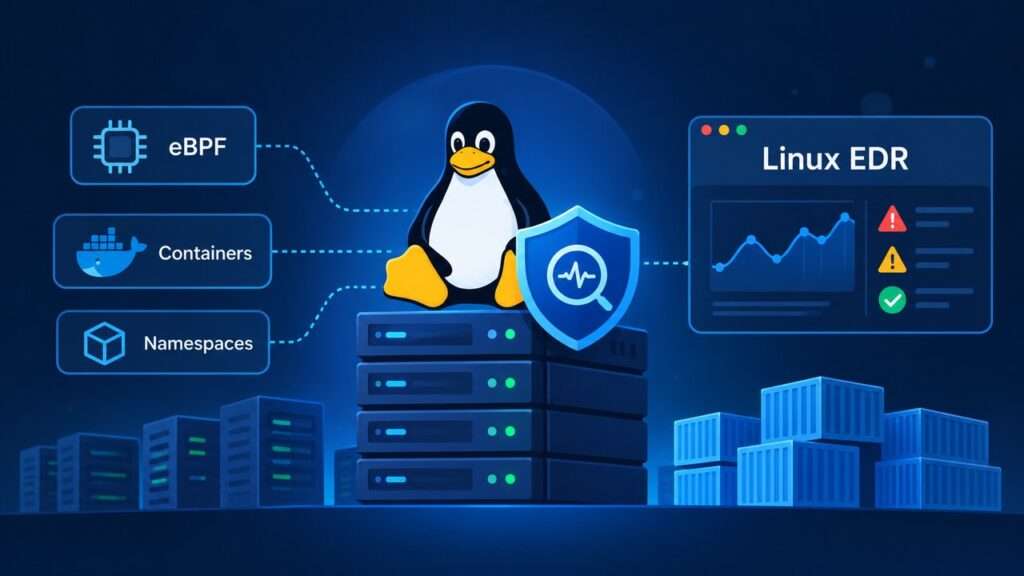
Many security articles treat Windows, macOS, and Linux as if the agent works the same way everywhere. In reality, Linux EDR faces very different operating system mechanics, faster-changing workloads, and heavy container activity. Understanding those differences helps explain why Linux visibility has its own strengths and blind spots.
1. Why Linux Is Not Just “Windows With Different Commands”
Many people picture a Linux server as basically a Windows laptop with different menus and commands. In reality, the way software runs and how security tools watch it is very different.
Windows comes from one company with a consistent setup and built-in monitoring tools that security software already knows how to plug into. Linux is more like a shared toolkit used to build many different systems:
- Many versions and setups: One company might run Ubuntu on a web server, another uses Debian or RHEL, and another uses a custom cloud setup. Security tools have to work across all those variations without breaking things.
- Busy servers instead of one person at a desk: A Windows laptop usually reflects one person opening apps, browsing, and working. A Linux server often runs websites, databases, or background jobs handling thousands of requests at once which creates a lot more routine noise for a security tool to sort through.
- Programs that blink in and out: On modern servers and containers, tiny helper tasks can start up, do their job in a fraction of a second, and close right away. If a security tool is slow to notice a task that lasts a blink of an eye, it can miss important clues about what happened.
2. How Linux EDR Collects Telemetry: From Old Hooks to eBPF
To see what a process is doing such as executing a command, opening a network socket, or accessing sensitive files an EDR sensor needs reliable signals from the kernel.
Older Approaches: auditd and Out-of-Tree Kernel Modules
- Audit framework (
auditd): Useful for logging specific rules, but heavy rule sets on busy servers can generate high log volume and CPU overhead. - Traditional kernel modules: Loading custom third-party kernel modules gives deep access, yet tight coupling to exact kernel versions and memory structures means a kernel update or bug can cause instability or kernel panics if not handled carefully.
Modern Standard: eBPF and LSM
Many modern Linux security sensors rely heavily on eBPF (Extended Berkeley Packet Filter) alongside LSM (Linux Security Modules) hooks:
- Safe execution in the kernel: Before an eBPF program attaches to a kernel hook or tracepoint, an in-kernel verifier checks that the program is safe (for example, that it terminates and does not read arbitrary out-of-bounds memory). That reduces the risk of crashing the kernel.
- Targeted event streaming: eBPF can observe events like process execution, file operations, or network activity and stream structured data to user space without needing a custom kernel module compiled for every single kernel quirk.
3. Containers, Namespaces, and Ephemeral Workloads
A huge share of modern Linux runs inside containers (such as Docker or Kubernetes pods) rather than standalone virtual machines. That changes what “an endpoint” looks like:
- Shared kernel, isolated namespaces: Containers on the same host share the host Linux kernel while using namespaces and cgroups to isolate process IDs (PIDs), network stacks, mounts, and resource limits.
- PID mismatches: A process might have PID
42 inside a container, while the host kernel sees it as PID 18492. A good Linux sensor has to resolve container metadata (container ID, image, pod, namespace) so analysts know which workload did what not just a raw host PID. - High churn: Containers and short-lived jobs come and go constantly. Security teams have to balance deep visibility against event volume, storage costs, and alert noise on busy clusters.
4. Practical Takeaways for Readers & Defenders
- Do not assume identical features across OSes: Even when a vendor supports both Windows and Linux, response actions, kernel telemetry depth, and tuning needs can differ.
- Watch the signal-to-noise ratio on servers: High-throughput Linux servers can overwhelm naive rules if every routine automation script or container restart looks suspicious.
- Context matters: Knowing which container, service account, or deployment pipeline spawned a process is often more helpful than looking at a single system call in isolation.